**The Curry That Crossed the Border: Massaman from the Southern Route**

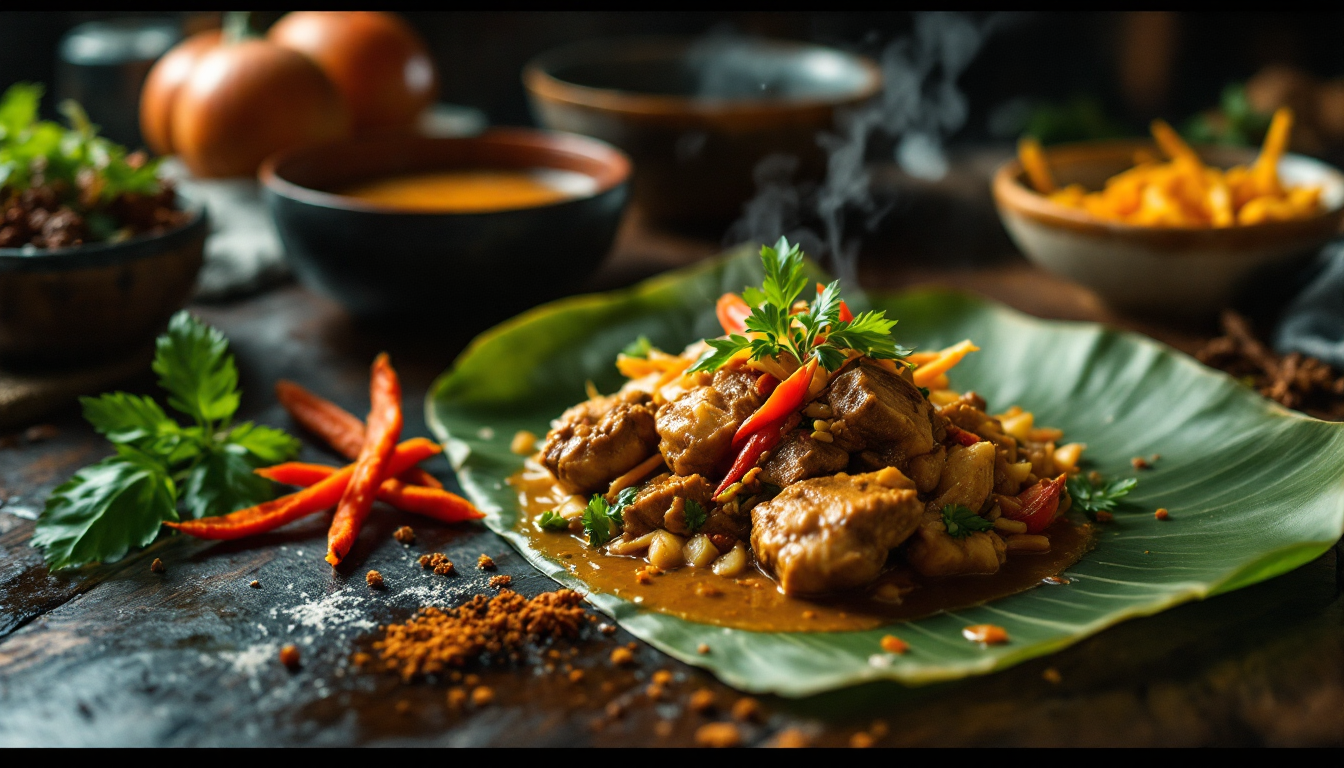
There's a dish that tells you exactly where you are in Thailand — not Bangkok, not the tourist coast, not the sanitized version of the cuisine. When you're eating Massaman in the south, near the border, you're eating the history of trade routes, Muslim fishing communities, Persian spice merchants who came through Ayutthaya, and Malaysian flavor logic that never stopped at any official checkpoint.
Khao Takiab sits at the right latitude for this. The Muslim fishing families at the pier don't cook Central Thai food at home. They cook this.
แกงมัสมั่น — Gaeng Massaman is what you're making today. And you're making the version that exists south of Bangkok — darker, richer, less sweet, spiced with more aggression than the tourist hotel version you've probably eaten in the States. Closer to the border, the cardamom gets louder. The dried chilies go up. The sweetness that Central Thai cooking loves gets pulled back in favor of something more complex and less polished.
This is Option A — a single dish designed for maximum complexity. You will hit every dimension: deep roasted spice warmth, sour tamarind brightness, the particular umami of fermented shrimp paste in the paste base, coconut richness, textural contrast from potatoes and roasted peanuts, bitter top notes from the paste's dried herbs, and the sweet that anchors everything without dominating it.
You've built paste from scratch. You know what that work costs and what it returns. Today we go deep.
### แกงมัสมั่นปลา — Gaeng Massaman Pla Massaman Curry with Gulf Fish — Southern Style
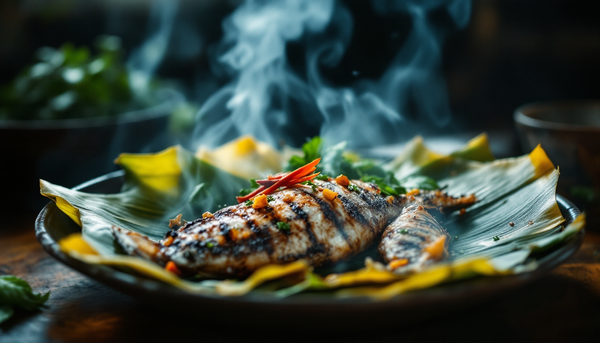
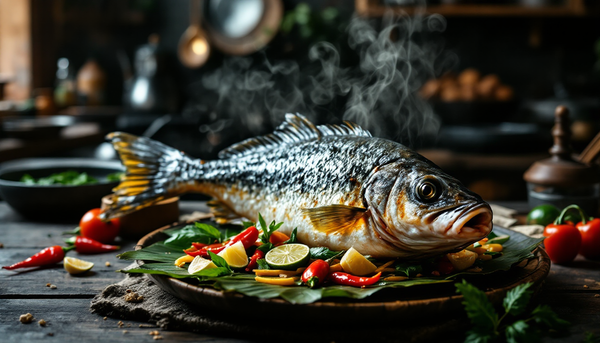
This version uses firm Gulf fish rather than the traditional beef or chicken — because you're at the pier, because the fish came off a boat this morning, and because seafood Massaman is what the fishing communities actually eat when they make this at home. Whole tamarind block, palm sugar, fish that still smells like the ocean. Scaled for two.
THE PASTE
Don't skip this. Buy it once when you arrive to understand the baseline. Then make it once and you'll never go back.
- 8 large dried guajillo-style chilies (or dried Thai long chilies, พริกแห้ง — soaked 20 minutes, seeds removed for moderate heat, seeds kept for your heat level) - 6 dried bird's eye chilies, whole — for the back heat - 1 tbsp whole coriander seed, toasted - 1 tsp whole cumin, toasted - 4 green cardamom pods, seeds only, toasted - 1 star anise, toasted - 1/2 cinnamon stick, broken, toasted - 4 cloves, toasted - 1/2 tsp white pepper - 6 cloves garlic, unpeeled — roasted directly over flame until charred and soft - 4 shallots — same treatment, flame-charred - 1 stalk lemongrass, bottom 4 inches only, sliced thin - 1-inch galangal, peeled, sliced — not ginger, the flavor is completely different and this is not the place to substitute - 1/2 tsp roasted shrimp paste (กะปิ — wrap in foil, roast directly on flame 2 minutes each side) - 1 tsp salt
Toast your whole spices dry in a pan until just fragrant — 60 to 90 seconds, not longer, you want warmth not carbon. Pound in a mortar in layers of hardness: dried chilies first with salt, then the woody aromatics, then the fresh, then the paste and roasted alliums. Thirty minutes of honest work. The result should hold its shape and smell like a border town in the best possible sense.
THE CURRY
- 400g firm white fish, skin-on — grouper (ปลาเก๋า) if the pier has it, Spanish mackerel (ปลาอินทรี) if not. Cut into 3-inch sections. Pat dry. - 400ml coconut cream — the first press, the thick one, not light - 200ml coconut milk — second press for loosening - 2 medium potatoes, waxy variety, peeled, cubed 3cm — par-cooked to just short of done - 3 tbsp roasted unsalted peanuts — roughly crushed, not powder - 3 tbsp tamarind paste — from a block, not the jar concentrate. Dissolve 40g tamarind block in 80ml warm water, push through a strainer, discard the fiber - 2 tbsp palm sugar (น้ำตาลมะพร้าว), shaved — or light brown sugar as a distant backup - 3 tbsp fish sauce (น้ำปลา) — add in stages, taste as you go - 4 makrut lime leaves — whole, bruised - 1 cinnamon stick - 2 cardamom pods, bruised - 2 star anise - Neutral oil
EXECUTION
In a heavy pot — a Dutch oven works, a proper Thai clay pot is better if you've sourced one by the time you make this — heat 2 tablespoons of oil over medium-high. You're going to fry the paste and this requires confidence.
Add your paste. It will spatter. Stay with it. Fry for 8 to 10 minutes, stirring constantly, until the paste goes from fragrant to deeply fragrant — the raw sharpness burns off and something richer emerges. You'll see the oil begin to separate from the paste at the edges. That's the signal.
Add the cinnamon stick, cardamom pods, star anise directly to the paste. Thirty seconds.
Add the coconut cream. Not the milk — the cream first. Let it come to a slow simmer and cook with the paste for 5 minutes. You're not rushing this. You're building.
Add potatoes and enough coconut milk to bring the liquid level to where you want it — this is a thick curry, not a soup. Simmer 10 to 12 minutes until the potatoes are fully cooked through.
Season: fish sauce in stages, tamarind paste, palm sugar. The balance here is yours to make — but you want a curry that is richer and more complex than it is sweet. Taste. Adjust. The tamarind should be present but not sharp. The sweetness should be felt without being named.
Add makrut lime leaves. Add peanuts.
Now the fish. Lay it in gently. Do not stir. Spoon curry over the top, cover, and simmer on low for 6 to 8 minutes depending on thickness. Fish is done when it resists gentle pressure and flakes cleanly at the thickest point. Do not overcook this. The fish is the reason you're at the pier.
Taste one final time. Add a last small hit of fish sauce if the depth needs anchoring.
SERVE
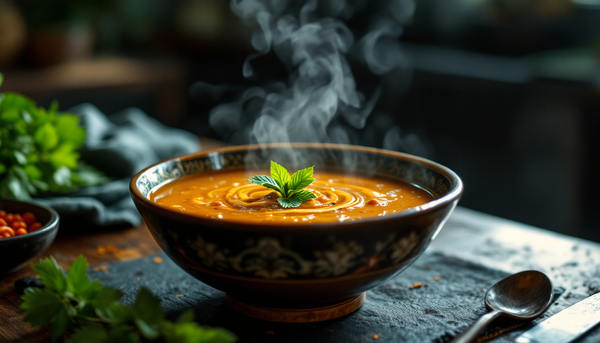
In deep bowls over jasmine rice. Not plated hotel-style — this is family food. Garnish with a few additional peanuts, a single fried shallot layer if you have it, nothing else. The curry is its own announcement.
SHOWMANSHIP NOTE
If you're serving guests, ladle the curry at the table from the pot. The aromatics — cardamom, star anise, cinnamon — are still rising. That first hit when the lid comes off is the experience. Don't plate in the kitchen and lose it.
SOUNDSCAPE
This is a slow-build dish with serious depth at the end. The cooking session has two registers: the paste work (physical, focused, requiring presence) and the long simmer (watching, tasting, adjusting).
For paste work: Moderndog — this is exactly the right energy for 30 minutes of mortar work, the raw grunge texture matches the physical demand.
For the simmer: เขียนไขและวานิช (Khian Khai Lae Wanit) — acoustic folk with the warm melancholy that belongs to long-simmering pots and cooling afternoon light through a kitchen window on the Gulf.
For the meal itself: BOWKYLION — the warmth and weight of her voice sits exactly right with this kind of food. Rich, unhurried, a little melancholic, completely at home in the south.
You'll make this dish multiple times. The first time to learn it. The second to find your version. By the third time, you'll adjust the paste ratio almost without thinking, and you'll know you've landed.
That's the border working on you. Let it.